 |
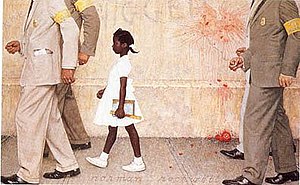
| The Problem We All Live With - painting by Norman Rockwell, 1964 |
Sitting in the half-light of the college classroom with 2 of my daughters, listening to Ms. Bridges' strong, soothing voice, I was thankful indeed that I hadn't given up. All the waiting and fretting had been worth it.
Weeks before, I had read about the opening night of the Norman Rockwell exhibit at the University's Museum of Art; how Civil Rights icon Ruby Bridges would be speaking, how the lecture was free and open to the public, but seating was limited. What a privilege, I had thought. This could be a once-in-a-lifetime experience for my children. I decided to bring my oldest.
But then, of course, the challenges began to surface. Richard would be out of town that evening on a business trip, so I'd have to arrange for a sitter for the younger kiddos. Then there was a meeting - no, now two meetings I was expected to attend, scheduled for that same time. I struggled, feeling this was too important an opportunity to miss, yet wanting to fulfill my responsibilities. As the evening of the lecture drew nearer, miracles began trickling in. Meetings were postponed and an angel mother-in-law was eager to help babysit. Now there was only the matter of obtaining the free tickets.
Announcements stated that wristbands would be handed out starting at 4pm that evening, though the lecture didn't start until 7pm. I had to bring all my little ones with me to stand in line. I arrived at 4 o'clock on the dot to find that some dedicated souls had been camped out in front of the museum since 11:00 am that morning. The line wound around the entire parking lot. It was cold and growing ever darker.
What. Am. I. Doing???
That's all I could think as the line crept forward and I fretfully tried to keep track of 6 restless children. The bell tower chimed on the half hour. We had parked in the 30 minute zone and were still only halfway to the front of the line. At this rate I knew I wouldn't be able to procure seats in the auditorium, but would have to settle for a remote location elsewhere on campus, watching the lecture on a projector screen. I was resigned to this. But as the minutes dragged on, it became clear that I'd hardly have enough time to even make it home for dinner before the lecture started! Finally, after an hour of standing in line, I texted my patient mother-in-law that we would meet her in 20 minutes -- She had arrived at our home before us!
Once we'd scarfed down some nourishment, my oldest daughter and my youngest piled back into the car with me and we raced back to campus. We meandered around the building and eventually found the correct room where we settled in with time to spare before the lecture began.
Ms. Bridges spoke of her experience from her childhood perspective. The way her parents and their friends spoke so excitedly and proudly of her acceptance into the school once reserved only for white children, Ruby thought she must be going to college! She gathered from their remarks that she was "so smart", and therefore must be entering some program of higher education. The first day of this new school, she noted the streets crowded with people and thought to herself that Mardi Gras had come. But she couldn't account for the hateful looks on their faces, or their bizzare behavior, waving high a black baby doll in a minature coffin. Though everyone told her how brave she was, Ruby didn't see her actions as anything noble. She did recall though, her first, powerful lesson learned upon meeting her new, white teacher, Mrs. Henry. She walked into the empty classroom and saw a woman who, by all outward appearences, looked just like the scores of white people lining the streets just outside. Yet, this woman was different. "I learned that day," Ms. Bridges shared "that you can't trust or mistrust a person based on how they look." And that, she said, is one of the most dangerous things about racism - it teaches us to trust bad people so long as they look the same as us.
While Ruby's chidlhood example is inspiring, what I found most compelling was the continual strengthening of her faith and capacity to love. I was very touched that she shared an intimate experience from more recent years, dealing with the murder of her oldest son. She had not been able to see her son when he was admitted to the emrgency room that night. He had directed the docter not to let his parents in the room since he did not want them to see him like this. Two years later, Ruby was admitted to a different ER having chest pains and numbness in her left arm. Despite these symptoms, the atending doctors could find no indication of a heart attack. They asked whether she had been under any stress. When she mentioned the death of her son 2 years prior, they dismissed it as having been too long ago to have any impact now. After the doctors had left the room, the older nurse who had been listening approached Ms. Bridges. She reassured her that these young doctors didn't know what they were saying. They didn't understand that grief takes as long as it takes. She asked Ruby where she lived. She asked about her son and found out when he had died. She listened closely and then told Ruby, "You're not havin' a heart attack."
"I'm not?"
"No. I used to work at that hospital across town. I'm the nurse who saw your son that night, and the good Lord sent you here tonight so I could tell you about it."
Ruby learned how her son had asked this nurse if he could hold her hand and call her mom. She found out that in his last moments he was faithful - he'd asked Christ to come into his heart and he was accepted into a better place of peace.
We had the opportunity to meet with Ms. Bridges after the lecture for a book signing. She requested no photography. This woman was sincere in her desires to be a promoter of peace. Mr. Rockwell may have immortalized her in his painting, but she understood that she was not a celebrity to be idolized, but a symbol of hope. Ruby Bridges stood and continues to stand for what we each might make of this world - a better place. To the many inquiries she receives as to what we can do to rid the world of the disease of racism, she says "I think we do the only thing we can do - We love and keep on loving. We reach out to our neighbors of different races, different religions and backgrounds and try to be a friend. That's what I do."
That's really all we can do. And I believe that it will be enough.
What. Am. I. Doing???
That's all I could think as the line crept forward and I fretfully tried to keep track of 6 restless children. The bell tower chimed on the half hour. We had parked in the 30 minute zone and were still only halfway to the front of the line. At this rate I knew I wouldn't be able to procure seats in the auditorium, but would have to settle for a remote location elsewhere on campus, watching the lecture on a projector screen. I was resigned to this. But as the minutes dragged on, it became clear that I'd hardly have enough time to even make it home for dinner before the lecture started! Finally, after an hour of standing in line, I texted my patient mother-in-law that we would meet her in 20 minutes -- She had arrived at our home before us!
Once we'd scarfed down some nourishment, my oldest daughter and my youngest piled back into the car with me and we raced back to campus. We meandered around the building and eventually found the correct room where we settled in with time to spare before the lecture began.
Ms. Bridges spoke of her experience from her childhood perspective. The way her parents and their friends spoke so excitedly and proudly of her acceptance into the school once reserved only for white children, Ruby thought she must be going to college! She gathered from their remarks that she was "so smart", and therefore must be entering some program of higher education. The first day of this new school, she noted the streets crowded with people and thought to herself that Mardi Gras had come. But she couldn't account for the hateful looks on their faces, or their bizzare behavior, waving high a black baby doll in a minature coffin. Though everyone told her how brave she was, Ruby didn't see her actions as anything noble. She did recall though, her first, powerful lesson learned upon meeting her new, white teacher, Mrs. Henry. She walked into the empty classroom and saw a woman who, by all outward appearences, looked just like the scores of white people lining the streets just outside. Yet, this woman was different. "I learned that day," Ms. Bridges shared "that you can't trust or mistrust a person based on how they look." And that, she said, is one of the most dangerous things about racism - it teaches us to trust bad people so long as they look the same as us.
While Ruby's chidlhood example is inspiring, what I found most compelling was the continual strengthening of her faith and capacity to love. I was very touched that she shared an intimate experience from more recent years, dealing with the murder of her oldest son. She had not been able to see her son when he was admitted to the emrgency room that night. He had directed the docter not to let his parents in the room since he did not want them to see him like this. Two years later, Ruby was admitted to a different ER having chest pains and numbness in her left arm. Despite these symptoms, the atending doctors could find no indication of a heart attack. They asked whether she had been under any stress. When she mentioned the death of her son 2 years prior, they dismissed it as having been too long ago to have any impact now. After the doctors had left the room, the older nurse who had been listening approached Ms. Bridges. She reassured her that these young doctors didn't know what they were saying. They didn't understand that grief takes as long as it takes. She asked Ruby where she lived. She asked about her son and found out when he had died. She listened closely and then told Ruby, "You're not havin' a heart attack."
"I'm not?"
"No. I used to work at that hospital across town. I'm the nurse who saw your son that night, and the good Lord sent you here tonight so I could tell you about it."
Ruby learned how her son had asked this nurse if he could hold her hand and call her mom. She found out that in his last moments he was faithful - he'd asked Christ to come into his heart and he was accepted into a better place of peace.
We had the opportunity to meet with Ms. Bridges after the lecture for a book signing. She requested no photography. This woman was sincere in her desires to be a promoter of peace. Mr. Rockwell may have immortalized her in his painting, but she understood that she was not a celebrity to be idolized, but a symbol of hope. Ruby Bridges stood and continues to stand for what we each might make of this world - a better place. To the many inquiries she receives as to what we can do to rid the world of the disease of racism, she says "I think we do the only thing we can do - We love and keep on loving. We reach out to our neighbors of different races, different religions and backgrounds and try to be a friend. That's what I do."
That's really all we can do. And I believe that it will be enough.
What a neat experience! I was impacted by that painting when I saw it at the Norman Rockwell exhibit.
ReplyDeleteAppreciate your comment, Wynter! I think this painting really leaves an impression in part because, while all of Rockwell's work is so expressive, most portray blissful, innocent stories. This one is so much heavier.
DeleteI'm glad you went to the effort to have this experience. Makes me wish I'd tried harder.
ReplyDeleteBut you can benefit from my sharing, Arianne! That's one of the main reasons I keep the blog.
Delete